
Conflicting views on Coal India (CIL) might leave investors confused. The bullish perspective that India has strong power demand (and also high steel production) means high demand for coal. As CIL is the monopoly producer of coal -- supplying over 80 per cent of the domestic requirement - the public sector undertaking should be a beneficiary of the rising power demand.

They realised that the Portuguese were better prepared to defend Daman than Dadra and Nagar Haveli. If reinforcements from Daman were to reach Silvassa, there was no chance of defeating the Portuguese. They decided that cutting Daman's communication lines would have to be their top priority before attacking Silvassa. A fascinating excerpt from Neelesh Kulkarni's new book, Uprising-The Liberation of Dadra and Nagar Haveli.

'India has many attractive features for the long-term investor; it combines: A low per capita income, a young population, and a heavier presence of high margin, asset-light firms in the technology sector.'

Market analysts are divided over the current fall in stock prices. While some say it is a healthy sign of a mature bull market, others feel the Indian markets may have entered a corrective phase, which can last for one to two quarters.
On the whole expect a very treacherous markets as the price levels could be driven purely by the technical play between bulls and bears as the new trend is established, cautions Sonali Ranade

The domestic benchmark indices - the S&P BSE Sensex and the National Stock Exchange Nifty50 - had lost close to 1.5 per cent in three days recently before gaining slightly. Notwithstanding weakness and volatility, the Nifty50 has managed to hold on to the 18,000 mark, while the Sensex has managed to stay above the 61,000 level. The performance of the stocks that comprise these front-line indices remains polarised.

'We suggest an equity strategy of 5% to 10% exposure to cash, 5% to Gold ETF, close to 50% to Sensex/Nifty/large mid-cap stocks.'

Urals and Sokol accounted for every 4 out of 5 barrels of Russian supplies to India last year.

The last time a bear attack was launched on a controversial businessman was when a cabal of brokers launched an assault in the early 1980s on what they thought was an over-priced Reliance share, recalls T N Ninan.
S&P's latest screen tracking the Berkshire bigwig's investing criteria uncovers 60 attractive names.

The price of bitcoin, the bestselling cryptocurrency, has shrunk nearly three times this year to mark the fate of such digital assets. Crashing prices, regulatory uncertainty and taxes have put Indian crypto exchanges in troubled waters. Finance Minister Nirmala Sitharaman's budget for FY23 announced a 30 per cent tax on any income from the transfer of virtual digital assets.

Market participants are hoping for a few tweaks on the taxation front which will encourage consumers and businesses to spend.

IndusInd Bank was the biggest gainer on the Sensex chart, rising 4.75 per cent, followed by M&M, L&T, NTPC, ITC, Ultra Cement, Tata Steel, Maruti and SBI. In contrast, Bajaj Finance, Tech Mahindra, Infosys and Sun Pharma were among the losers, shedding up to 2.30 per cent.
We are pretty much towards the end of a bear market in terms of wave counts and these are times to accumulate blue chips, not sell, says Sonali Ranade
Near the bottom of bear markets, broad buy signals are generated by several rules-of-thumb. Those check out positive. The first buy signal is that the earnings yield is higher than the yield from risk-free instruments.

The net leasing of Grade-A commercial office space in India will stagnate this financial year at 32-34 million square feet, with global uncertainties brewing caution among key tenant categories, according to the latest Crisil Ratings report. Major seven cities in India - Bengaluru, Chennai, Hyderabad, Kolkata, Mumbai Metropolitan Region (MMR), National Capital Region (NCR) and Pune - had Grade-A office space with an operational stock of around 705 million square feet as of March 2023. India's commercial office space is dominated by technology companies, with information technology (IT) and IT-enabled services (ITeS) companies occupying 42-45 per cent of the operational stock.

Are faulty design, hurried construction and private ownership to be blamed for the incidents of airport roofs crashing?
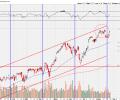
The dollar's preliminary moves after the low 80.90 are supportive of a like dollar rally back to 85.50. We should see confirmation of that in the early part of next week, says Sonali Ranade

The stocks Radhakishan Damani enters or exits are closely watched by fund managers, says Joydeep Ghosh.

Deteriorating ties between India and Canada could have a bearing on flows into the domestic capital markets. At present, Canada is the seventh largest country for foreign portfolio investor (FPI) flows into India. According to the National Securities Depository Ltd (NSDL), the assets under custody (AUC) of FPIs domiciled in Canada stood at nearly Rs 1.8 trillion ($21 billion) at the end of August. Almost 85 per cent of these investments are in listed equity, while the remaining in debt and hybrid instruments.

BSE Healthcare, Oil & Gas, Consumer Durable, TECk, Power and Metal indices declined between 0.5-1%.

'Earnings will be the catalyst for markets to march higher from here on out.'

Going ahead, experts say, the fundraising trend in the primary market will depend on how the secondary market performs against the backdrop of the outcome of general elections and global cues.

Individuals following this approach need to be more disciplined, optimistic and need some serious luck.

Benchmark indices Sensex and Nifty slid for a seventh straight session on Monday, logging their longest losing run in the past five months, following a bearish trend in global markets amid concerns over aggressive rate hikes by developed economies. Fresh foreign fund outflows and losses in IT, auto and oil stocks also dented investor sentiments. The BSE Sensex declined by 175.58 points or 0.30 per cent to close at 59,288.35 with 17 of its shares posting losses.

Seven out of the 10 listed firms of Adani group have received show cause notices from the Securities and Exchange Board of India (Sebi) for alleged violation of related party transactions and non-compliance with listing regulations, the companies said in their regulatory filings to the stock exchanges. While group's flagship Adani Enterprises Ltd, renewable energy firm Adani Green Energy Ltd (AGEL) and city gas distributor Adani Total Gas Ltd said Sebi sent notices of their parent or holding company controlled by conglomerate's chairman Gautam Adani, ports company Adani Ports & Special Economic Zone, Adani Power, electricity transmission firm Adani Energy Solutions, and commodities firm Adani Wilmar said they have received Sebi notices.
Economic cracks are already beginning to form along China's Great Wall.

Beyond a point, competition is boring. The fun is in the doing, irrespective of outcome. By the time I was in college, I knew I valued awareness more than success, notes Shyam G Menon.

The market breadth was negative. Out of 2,855 stocks traded on the BSE, there were 1086 advancing stocks as against 1,642 declines.

'The focus needs to shift towards the ability to collect payments, particularly in tier-3 to tier-4 areas where acceptance is still lacking.'
Over 120 dividend paying companies currently have a dividend yield of over five per cent, according to a study. The dividend yield is based on the current market price and dividend paid in the financial year 2005-06.

Macroeconomic management is usually a lot more comfortable with lower fiscal deficits. The sooner we get there, the better for the economy, says former Chief Economic Adviser to the Government of India Shankar Acharya.

At 23 price-to-earning, the tech story is no longer compelling.

HDFC Bank, Reliance Industries and Housing Development Finance Corporation (HDFC) -- with free-float market cap of over Rs 3 trillion -- have the highest weight in the Sensex and the Nifty.
A well-balanced board of directors, proactive shareholders and swift action against malpractices could restore market confidence.
Mark Mobius, the 71-year old investment guru and executive chairman of Franklin Templeton Investments, has a positive view on the Indian market and feels that stock valuations have become attractive after the 27 per cent cut in benchmark equity indices since late January.Stating that it was difficult to predict the end of the current phase, Mobius said he expected the decoupling to continue in the long term.
The bears are likely to tighten their grip on the market in the short term, following hardening of interest rates by the Reserve Bank amid negative cues from global markets, say analysts.

Firms to find alternative export routes or face increased trade barriers

If investing in Bitcoin, adopt a three to five-year horizon and invest systematically to gain from its volatility.
